



BEIJING, July 25, 2026 /PRNewswire/ — A news report from China Daily:

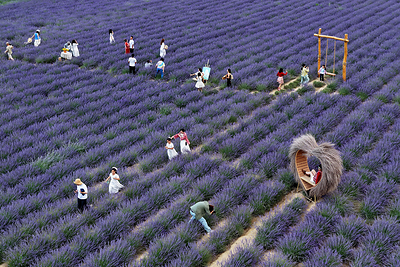
Leveraging its thriving lavender industry, Sigong village in Xinjiang’s Ili Kazak autonomous prefecture cultivates a unique rural getaway integrating eco-tourism, leisure and cultural exploration. Liu Xiaoming / for China Daily
At the height of summer, 800 hectares of lavender are in bloom across Sigong village — also known as Huanghuang village — at the foot of the Tianshan Mountains in the Ili Kazak autonomous prefecture in Xinjiang Uygur autonomous region, drawing tourists to the scenic spot.
Located in Huocheng county, Sigong village, once a barren wasteland, began lavender cultivation in 2009 under government guidance. After more than a decade of development, it has since blossomed into a hot spot welcoming hundreds of thousands of visitors annually. Now the village anchors local industry, turning the crop into a key engine for rural vitalization.
Liu Heimu, a painter, traveled from Shanghai to attend the lavender culture and tourism festival held in June.
In August 2025, Liu first visited Sigong village, captivated by its scenery and rustic charm. In just two weeks, he produced more than 80 artworks. On this return visit, Liu brought along his newly published portfolio and donated a large-scale painting to the Huocheng county government.
“I’m drawn to both the lavender and the unhurried lifestyle,” he said. “This is where I plan to spend my retirement.”
Each year, the village draws throngs of domestic tourists and a growing number of international visitors. It’s not just the blooms but the slow pace of life that draws visitors. Converted courtyards serve as cozy homestays, anchoring a laid-back vibe. Since 2019, Sigong village has promoted a “pastoral poetry” theme, bundling lodging, dining and cultural experiences to encourage longer stays and boost spending.
Leveraging its vast lavender fields, Huocheng county has expanded with supporting businesses such as homestays and restaurants in Sigong village, encouraging locals to start ventures. The village now boasts 72 distinctive homestays, with this clustered development emerging as a highlight of rural tourism.
Zhang Shunhai, 63, a villager in Sigong, is a prime beneficiary of this transformation. In 2022, Zhang made a bold move, demolishing his old adobe house to build eight bright guest rooms on his 0.13-hectare plot with his life savings. “The ‘purple economy’ was booming, and it was the perfect time to open a homestay,” Zhang recalled.
After clearing the old structure, he leased part of the space to young entrepreneurs, whose coffee shops, photo studios, and dessert stores became the village’s new landmarks, earning him about 100,000 yuan ($14,760) annually in rent.
To his surprise, his guest rooms were fully booked throughout the lavender season in the first year. Now, the homestay alone brings in over 100,000 yuan a year, freeing him from the uncertainties of farming.
“We used to struggle with poor utilities and potholed roads; now we have modern amenities and a brand-new village. Chatting with tourists from all over makes me feel younger,” Zhang said.
“Who would have thought I’d live to see such good fortune? As the lavender and our homestay took off, we became an internet sensation. We’re all so proud. Over the past decade, my income has increased five or sixfold,” he added.
Moving beyond a tourism-based development model, Huocheng county is focusing on processing to extend the lavender industry chain and boost added value.
Xinjiang Natural Aromatic Agricultural Technology, a flagship enterprise, is engaged in the full-industry-chain development of lavender and other signature plants. Through partnerships with universities including Xinjiang University and Jiangnan University, the company said it has invested over 5 million yuan in research and development, rolling out 360 products across seven distinct series.
Currently, Huocheng county is home to 31 lavender processors and distributors. This industrial ecosystem is delivering tangible benefits to local growers. “Crop farming used to bring slim returns,” said Gao Zeng, a Sigong villager. “Since switching to lavender, our incomes have climbed steadily year after year.”
Leveraging its national modern agriculture industrial park, Huocheng county has scaled up standardized cultivation and modern essential oil extraction across its 2,000 hectares of lavender fields. The county follows an integrated framework linking leading enterprises, farmer cooperatives and family farms. This structure engages 28 processors, 63 cooperatives and 94 family farms, advancing the sector’s transition toward high-efficiency modern production.
Nigara Abdunabi, director of the rural development center in Sigong village, said: “Both the livelihoods of our villagers and the look of our village have been transformed. Thanks to the lavender industry, every household is better off. Renovated courtyards have beautified the village, and upgrades to the water supply, drainage, greening and street lighting have truly given the place a fresh new look.”